Monday 18th October, 2010
Big News Network.com Saturday 16th October, 2010
A spokesperson for the Chinese Commerce Ministry alleges the US is using the yuan as a scapegoat, despite ongoing criticism of China's restrictive financial system.
China has told the United States not to make the yuan, their national currency, a scapegoat for domestic problems with the US dollar, in a new twist to the deteriorating trade conflict between the world’s two biggest economies.
Yao Jian, a spokesperson for the Chinese Commerce Ministry made the comments just hours before the United States decides whether to formally label their biggest trade competitor a currency manipulator due to allegations of China artificially depressing the value of the yuan.
Jian accused the US government of looking only at China’s trade surplus as evidence of currency manipulation, rather than considering whether that trade surplus was the result of China’s legitimate supremacy over the US in the current financial climate.
China offers a cheaper alternative to most developed countries, which makes it difficult to compete with the export giant, especially in a financial climate in which businesses and governments are seeking to save money wherever they can.
China remains under pressure from major economies such as Japan and the US to enact faster currency reforms in the Asian powerhouse, which is renowned for a financial system that remains restrictive compared to other major economies.
BACK to margotbworldnews.com
Showing posts with label Markets. Show all posts
Showing posts with label Markets. Show all posts
Monday, October 18, 2010

Sunday, October 17, 2010
Over 80 million threatened by poverty in EU Society
BRUSSELS, Oct 17 (KUNA) -- The European Union (EU) is one of the richest regions in the world, yet over 84 million people are still threatened by poverty, EU Commissioner for Employment and Social Affairs Laszlo Andor said here in a statement today to mark the International day for the Eradication of Poverty.
The decision to lift at least 20 million people out of poverty by 2020 sends a powerful message that the EU takes social inclusion very seriously, he added.
The 27-member European bloc has a population of over 500 million people.
"The International Day for Eradication of Poverty is a day when the whole world is reminded that there are people who suffer from poverty and we need to act together to make a difference," he added.
On his part, EU Commissioner for Development, Andris Piebalgs declared that radicating poverty is also a global challenge. "Today, 1.4 billion people in the developing world are still denied the chance to build a future by living in extreme poverty. In September, global leaders gave a new impetus to the fight against poverty and committed to make the Millennium Development Goals a success by 2015," he noted.
The UN summit on MDGs in September adopted a global action plan to achieve the anti-poverty goals by 2015. (end)
nk.mt KUNA 171332 Oct 10NNNN
BACK to margotbworldnews.com
The decision to lift at least 20 million people out of poverty by 2020 sends a powerful message that the EU takes social inclusion very seriously, he added.
The 27-member European bloc has a population of over 500 million people.
"The International Day for Eradication of Poverty is a day when the whole world is reminded that there are people who suffer from poverty and we need to act together to make a difference," he added.
On his part, EU Commissioner for Development, Andris Piebalgs declared that radicating poverty is also a global challenge. "Today, 1.4 billion people in the developing world are still denied the chance to build a future by living in extreme poverty. In September, global leaders gave a new impetus to the fight against poverty and committed to make the Millennium Development Goals a success by 2015," he noted.
The UN summit on MDGs in September adopted a global action plan to achieve the anti-poverty goals by 2015. (end)
nk.mt KUNA 171332 Oct 10NNNN
BACK to margotbworldnews.com
The Rot Within: Our Culture of Financial Fraud and the Anger of the Honest (October 15, 2010)
Misrepresentation, fraud and gaming the system are all heavily incentivized in the U.S. culture and economy, and honesty is punished. This truth is finally being revealed on a grand scale. The coming implosion of the U.S. economy has been richly earned. Today I am publishing a commentary by an accountant with decades of experience in high-level global consulting firms and Fortune 50 U.S. corporations. What he has observed is unknown to the vast majority of Americans.
I have documented the poisoning of the nation's culture and economy by a "game the system"/exploitation mentality:
The Coming Collapse of the Real Estate Market
Runaway Feedback Loops, Wealth Concentration and Gaming-The-System
Imagining A Middle Class Does Not Create One
With accountability effectively lost, cheating, lying, misrepresention, embezzlement and fraud, both petty and monumental, have all been incentivized. Thus the "little people" game the welfare/entitlement system and the Financial Elites game the mortgage market, and everyone gamed whatever piece of the housing bubble they could grab.
Where does that leave the honest citizenry? At an extreme disadvantage. Lying, sins of omission, misrepresentation and doing the bidding of evil organizations gets you bonuses and career advancement, while refusing to game the system as instructed gets your fired.
How does that make honest people feel? How about righteously angry?
I'd like to provide some context for this commentary from the Survival+ critique. Here is how I would summarize an integrated understanding of our plight:
1. Humans are selected to seek windfalls and exploit them. I call this windfall exploitation. It is neither good nor bad, it is simply a profoundly advantageous strategy in a hunter-gatherer-wanderer environment.
Individuals can maximize their gain by exploiting windfalls alone, but some windfalls are better exploited by groups. This is the basis of cooperation, which is expressed in both capitalist and socialist systems.
2. The natural resources windfalls have all been exploited. In general, the natural resources are in depletion and there is active competition for them which reduces the windfall.
3. Neoliberal Capitalism developed a solution for this paucity of natural windfalls: the partnership of the Financial Elites and the Central State. The Central State gathered powers of taxation and control which enable it to "enforce" the collection of the national income which can be channeled to its cronies in wealthy (and hence politically powerful) cartels.
The investment banking/mortgage banking industries are the example of this dynamic par excellence. (Please see The Coming Collapse of the Real Estate Market for more.)
4. The last significant windfall available to advanced global Capitalism was the financialization of the global economy. In the U.S., we see this clearly in the financial share of corporate profits; from a pittance in the "real growth" decades of the 1950s and 60s, finance-derived profits came to dominate Corporate America's profits.
5. This financialization effected a net transfer of public and private income streams and wealth from the citizenry and State to the coffers of the financial Elites. As actual productivity and wealth-creation declined, so did wages and incomes when priced in purchasing power.
To offset that decline, people, companies and governments replaced income with debt: they borrowed to fill the gap between their desires/commitments/spending and their net income.
The financial Elites were happy to supply the debt and capture the income streams of servicing that debt. By securitizing those debts and writing derivatives against them, the Elites created a stupendously profitable windfall to exploit. The Central State and its central bank were happy to comply, as they are in partnership with the Elites which enrich and empower them.
6. The net result of this expansion of credit is asset bubbles. When the asset bubbles pop, the debts remain, impoverishing the over-indebted holders of the busted assets.
7. Unfortunately for the Financial Elites, this destruction of assets and debt feeds runaway feedback loops which threaten the entire foundation of their wealth and control.
8. The strategy of both the Financial Elites and the Central State (its willing partner in exploitation of the citizenry) is to conjure up simulacra to replace the truth, which is fatally dangerous to the status quo that is now completely dependent on maintaining a culture of financial untruths.
The order of the day is thus necessarily propaganda, bogus balance sheets, toothless facsimiles of "reform" presented as "real reform," and endless frauds, embezzlements, lies, misrepresentations, omissions, etc., all of which have come to full flower in the credit-housing bubble/mortgage-forclosure debacle.
This is why the Financial Power Elites and the Federal Government are both wedded to lies, half-truths, misrepresentation, omissions, fraud, corruption and the full panoply of propaganda. To tell the truth is to bring down the entire status quo.
Here is our accountant's commentary:
If you would like to post a comment where others can read it, please go to DailyJava.net, (registering only takes a moment), select Of Two Minds-Charles Smith, and then go to The daily topic. To see other readers recent comments, go to New Posts.

BACK to margotbworldnews.com
I have documented the poisoning of the nation's culture and economy by a "game the system"/exploitation mentality:
The Coming Collapse of the Real Estate Market
Runaway Feedback Loops, Wealth Concentration and Gaming-The-System
Imagining A Middle Class Does Not Create One
With accountability effectively lost, cheating, lying, misrepresention, embezzlement and fraud, both petty and monumental, have all been incentivized. Thus the "little people" game the welfare/entitlement system and the Financial Elites game the mortgage market, and everyone gamed whatever piece of the housing bubble they could grab.
Where does that leave the honest citizenry? At an extreme disadvantage. Lying, sins of omission, misrepresentation and doing the bidding of evil organizations gets you bonuses and career advancement, while refusing to game the system as instructed gets your fired.
How does that make honest people feel? How about righteously angry?
I'd like to provide some context for this commentary from the Survival+ critique. Here is how I would summarize an integrated understanding of our plight:
1. Humans are selected to seek windfalls and exploit them. I call this windfall exploitation. It is neither good nor bad, it is simply a profoundly advantageous strategy in a hunter-gatherer-wanderer environment.
Individuals can maximize their gain by exploiting windfalls alone, but some windfalls are better exploited by groups. This is the basis of cooperation, which is expressed in both capitalist and socialist systems.
2. The natural resources windfalls have all been exploited. In general, the natural resources are in depletion and there is active competition for them which reduces the windfall.
3. Neoliberal Capitalism developed a solution for this paucity of natural windfalls: the partnership of the Financial Elites and the Central State. The Central State gathered powers of taxation and control which enable it to "enforce" the collection of the national income which can be channeled to its cronies in wealthy (and hence politically powerful) cartels.
The investment banking/mortgage banking industries are the example of this dynamic par excellence. (Please see The Coming Collapse of the Real Estate Market for more.)
4. The last significant windfall available to advanced global Capitalism was the financialization of the global economy. In the U.S., we see this clearly in the financial share of corporate profits; from a pittance in the "real growth" decades of the 1950s and 60s, finance-derived profits came to dominate Corporate America's profits.
5. This financialization effected a net transfer of public and private income streams and wealth from the citizenry and State to the coffers of the financial Elites. As actual productivity and wealth-creation declined, so did wages and incomes when priced in purchasing power.
To offset that decline, people, companies and governments replaced income with debt: they borrowed to fill the gap between their desires/commitments/spending and their net income.
The financial Elites were happy to supply the debt and capture the income streams of servicing that debt. By securitizing those debts and writing derivatives against them, the Elites created a stupendously profitable windfall to exploit. The Central State and its central bank were happy to comply, as they are in partnership with the Elites which enrich and empower them.
6. The net result of this expansion of credit is asset bubbles. When the asset bubbles pop, the debts remain, impoverishing the over-indebted holders of the busted assets.
7. Unfortunately for the Financial Elites, this destruction of assets and debt feeds runaway feedback loops which threaten the entire foundation of their wealth and control.
8. The strategy of both the Financial Elites and the Central State (its willing partner in exploitation of the citizenry) is to conjure up simulacra to replace the truth, which is fatally dangerous to the status quo that is now completely dependent on maintaining a culture of financial untruths.
The order of the day is thus necessarily propaganda, bogus balance sheets, toothless facsimiles of "reform" presented as "real reform," and endless frauds, embezzlements, lies, misrepresentations, omissions, etc., all of which have come to full flower in the credit-housing bubble/mortgage-forclosure debacle.
This is why the Financial Power Elites and the Federal Government are both wedded to lies, half-truths, misrepresentation, omissions, fraud, corruption and the full panoply of propaganda. To tell the truth is to bring down the entire status quo.
Here is our accountant's commentary:
I belong to a large number of finance organizations and sometimes I even assist clients with hiring a finance person. Since I have a lot of experience with finance and accounting, when I am interviewing these people I know when I am getting a BS answer and unlike most BS recruiters I do not steer away from controversy since I am truly looking for the most qualified for my clients and not who is just most marketable to them. After I start drilling down you would be amazed (or maybe you wouldn’t) how many of these CFO’s and Controller types were basically dismissed because they would not cook the books in some manner. Now maybe I have told you that I was asked to resign from one of the nations largest companies (a company that I worked hard for and saved from bankruptcy and due to my actions had created) in the US because I refused to book a revenue entry for over a million dollars which was unsupported and the CFO (I had been the CFO up until a merger) blew up with me when I asked him to send a memo telling me to record it. Funny, a few years and one acquisition later it melted down as one of the biggest accounting frauds in US history.The anger of the honest will soon know no bounds, and the guilt of the complicit will settle like a silent pall over the nation: guilty as charged. Who will raise their hands to plead the guilt we all see and know?
My next gig as the CFO for a NYSE company I basically walked in and found what I would consider a $60 million dollar accounting fraud in one day (once again a mark to market issue draining cash flow and sucking the company into a dark hole). Corrected that accounting problem and the company began to prosper but since I thought the board and upper management was so corrupt I left (Chairman of the Audit Committee was found guilty at another large company for back dating options).
The next public company where not only was I the CFO but prior to that a board member, I was basically asked to resign for BS reasons a couple of weeks later after I pointed out what the board was asking me to do was basically wire fraud and of course they backed off quickly and said they would get a legal opinion from our law firm (one of the top 10 in the US) to cover me. In the same meeting our outside legal counsel said he had a problem giving such an opinion and I pointed out that a legal opinion did not keep me from being both civil and criminally liable. It should be noted that this was another company that 2 years before I came in and took the reins as CFO/COO and pulled the company out of black hole of looming bankruptcy and made it profitable in the first time in its history since it went public and then refinanced the company. In summary a year after I left the company had burned through the money I raised and the Board sold the company for nothing.
There is lots of bitterness out there with the straight shooting finance people. Many of them find themselves unemployable. This stretches from banks, Private Equity, Investment Banking, through the large accounting firms (the average partner in the large accounting firms any more is a pathological liar) to senior finance people in organizations. Right before Enron and MCI blew-up, I actually had a BS HR person tell me I was not flexible enough. I wanted to tell this idiot that I knew where flexibility got me and it was an orange jumpsuit. Bankers and Companies only hire the weakest and most pliable senior finance executives they can find.
One other short story. A while back I was at a networking meeting with a large group of CFO and ex-CFO’s. I asked this group how many thought that most CEO’s wanted a weak CFO working for them. Approximately 70% of the attendees raised their hand! You have to remember that the only person who had steady access to the Board is the CFO.
The point, the middle class is becoming torn and frayed and there is real anger out there. The common belief is that only the liars and thieves are moving ahead in this country.
If you would like to post a comment where others can read it, please go to DailyJava.net, (registering only takes a moment), select Of Two Minds-Charles Smith, and then go to The daily topic. To see other readers recent comments, go to New Posts.
BACK to margotbworldnews.com
Former UK Chancellor says West is running out of money
Kenneth Clarke, the former UK chancellor, has warned the West is in grave danger of financial collapse.
Now the Justice Secretary under Britain's coalition government, Mr Clarke told a conference of prison authorities that the country faced "quite the most dramatic spending cuts in living memory."
In a forceful address to his audience, he said: "There is an extremely serious financial crisis. I actually am one of those who believes, with a grave danger of financial collapse, we’re not out of the woods in the Western world yet.
Speaking prior to next week’s comprehensive spending review, which will see most Government departments’ budgets cut by 25 per cent over four years, the Justice Secretary said: "These are difficult circumstances. There’s no one alive who remembers a crisis of this kind. It is not the usual public spending squeeze."
His remarks appeared to contradict the Prime Minister, who insisted days ago that the Coalition’s early decisions have put Britain out of the danger zone.
When the comments were put to Mr Clarke, he said: "We have rescued ourselves...at the moment".
He told the prison governors there would be no extra money available to drive through the Government’s radical jail reforms in which the government wants inmates to work a 40-hour week, in return for the minimum wage.
Mr Clarke said: "I want to be clear, so far as all these reforms go, we don’t have any money."
Big News Network.com Sunday 17th October, 2010
BACK to margotbworldnews.com
Now the Justice Secretary under Britain's coalition government, Mr Clarke told a conference of prison authorities that the country faced "quite the most dramatic spending cuts in living memory."
In a forceful address to his audience, he said: "There is an extremely serious financial crisis. I actually am one of those who believes, with a grave danger of financial collapse, we’re not out of the woods in the Western world yet.
Speaking prior to next week’s comprehensive spending review, which will see most Government departments’ budgets cut by 25 per cent over four years, the Justice Secretary said: "These are difficult circumstances. There’s no one alive who remembers a crisis of this kind. It is not the usual public spending squeeze."
His remarks appeared to contradict the Prime Minister, who insisted days ago that the Coalition’s early decisions have put Britain out of the danger zone.
When the comments were put to Mr Clarke, he said: "We have rescued ourselves...at the moment".
He told the prison governors there would be no extra money available to drive through the Government’s radical jail reforms in which the government wants inmates to work a 40-hour week, in return for the minimum wage.
Mr Clarke said: "I want to be clear, so far as all these reforms go, we don’t have any money."
Big News Network.com Sunday 17th October, 2010
BACK to margotbworldnews.com
Friday, October 15, 2010
10 Things You Really, Really Don't Need
Shopping is an adrenaline rush. How else to explain the talking ceramic cat you had to have, or the face cream that you bought because it was guaranteed to return your skin to the hue it had in the womb? Sure, the Great Recession has shifted Americans’ shopping habits, but we’re still a spending force to be reckoned with. Luckily, there are things we just don’t need on this planet. So take a look at some items you might want to trim from your shopping list.
1. Microwave oven
I haven’t had a microwave since Clinton was in the White House. Sure, on occasion I’ll miss the opportunity to melt down butter without burning it on the stove. I’d just rather give the counter space to something more deserving, like cookies. Or cupcakes. Or brownies…
2. Electric wine bottle openers
Waiters can open a bottle of organic wine, at the table, with just a mere flick of a wrist and cork-screw. Mentally raising a cork out of the bottle with special brain powers would be cooler, but for now a simple corkscrew works fine. And gives good strength training!
3. Bread machines
Sure, bread machines can be an awesome way to get perfectly-shaped loaves of steamy, fresh bread. But allow us to face the delicious reality of fresh bread. If you’re taking the time to make fresh bread in your bread machine, you probably have the time to bake fresh bread in your oven. Hard realities, folks. Hard realities.
4. Neck creams
It’s become casual sport in Hollywood to guess an actress’ age by her neck, which still remains hard to control by Botox or a lift. So now there’s a whole industry of creams dedicated to the neck. In reality, you should just use the same creams and treatments on your neck as you do on your face. Moisturize tone, mask – just bring it down a few inches lower than your jaw line.
5. Beauty products tested on animals
To which we and super cute-bunny-that-fits-in-a-hand say – really? Products like said Botox are continually tested on animals with appalling results. There’s a whole world of products, beauty or otherwise, that are cruelty-free. You can find them here.
6. Hand sanitizers
I’m not saying medical professionals should go without, or that we should immediately start diving into gas station bathrooms to dance around barefoot. But washing your hands will kill germs just as easily as hand sanitizers. Sanitizing your paws every time you touch a door knob will kill most bacteria. But the tough ones that survived will multiply and will be stronger than the cousins you killed off. (Read more about that here.)
7. The latest product from Apple
iPods are fun. As are iPhones and yes, even iPads are kind of cool. Do they get more fun as the latest updates cycle through every year and/or month? (As giant UFOs bearing the Apple insignia lower into our horizons.) Sure, maybe we all need the ability to instantly play music/record/brew latte with our phones. But why not let your old apples actually fall from the tree before you replace them?
8. Automatic toilet flushers
One of the greatest questions of our time is obviously – do toilets really need to flush on their own, causing us to flee to the other side of the stall to avoid splash back? And repeat.
9. Motion-Activated Anything
Recently, I saw an advert for a motion-activity candy dispenser. (Because obesity isn’t enough of a problem in this country. Yes, I’m waving a cranky cane right now.) Motion-activated devices are fantastic for people with disability issues. But how many wheelchairs do we see on escalators? We also opened doors for centuries without the power of electricity.
10. Throw pillows
When you’re lost under a gigantic pile of plush, you have no one but yourself to blame.
This post first appeared on EcoSalon.
© 2010 EcoSalon All rights reserved.
View this story online at: http://www.alternet.org/story/148474/
By Katherine Butler, EcoSalon
Posted on October 15, 2010
http://www.alternet.org/story/148474/
BACK to margotbworldnews.com
1. Microwave oven
I haven’t had a microwave since Clinton was in the White House. Sure, on occasion I’ll miss the opportunity to melt down butter without burning it on the stove. I’d just rather give the counter space to something more deserving, like cookies. Or cupcakes. Or brownies…
2. Electric wine bottle openers
Waiters can open a bottle of organic wine, at the table, with just a mere flick of a wrist and cork-screw. Mentally raising a cork out of the bottle with special brain powers would be cooler, but for now a simple corkscrew works fine. And gives good strength training!
3. Bread machines
Sure, bread machines can be an awesome way to get perfectly-shaped loaves of steamy, fresh bread. But allow us to face the delicious reality of fresh bread. If you’re taking the time to make fresh bread in your bread machine, you probably have the time to bake fresh bread in your oven. Hard realities, folks. Hard realities.
4. Neck creams
It’s become casual sport in Hollywood to guess an actress’ age by her neck, which still remains hard to control by Botox or a lift. So now there’s a whole industry of creams dedicated to the neck. In reality, you should just use the same creams and treatments on your neck as you do on your face. Moisturize tone, mask – just bring it down a few inches lower than your jaw line.
5. Beauty products tested on animals
To which we and super cute-bunny-that-fits-in-a-hand say – really? Products like said Botox are continually tested on animals with appalling results. There’s a whole world of products, beauty or otherwise, that are cruelty-free. You can find them here.
6. Hand sanitizers
I’m not saying medical professionals should go without, or that we should immediately start diving into gas station bathrooms to dance around barefoot. But washing your hands will kill germs just as easily as hand sanitizers. Sanitizing your paws every time you touch a door knob will kill most bacteria. But the tough ones that survived will multiply and will be stronger than the cousins you killed off. (Read more about that here.)
7. The latest product from Apple
iPods are fun. As are iPhones and yes, even iPads are kind of cool. Do they get more fun as the latest updates cycle through every year and/or month? (As giant UFOs bearing the Apple insignia lower into our horizons.) Sure, maybe we all need the ability to instantly play music/record/brew latte with our phones. But why not let your old apples actually fall from the tree before you replace them?
8. Automatic toilet flushers
One of the greatest questions of our time is obviously – do toilets really need to flush on their own, causing us to flee to the other side of the stall to avoid splash back? And repeat.
9. Motion-Activated Anything
Recently, I saw an advert for a motion-activity candy dispenser. (Because obesity isn’t enough of a problem in this country. Yes, I’m waving a cranky cane right now.) Motion-activated devices are fantastic for people with disability issues. But how many wheelchairs do we see on escalators? We also opened doors for centuries without the power of electricity.
10. Throw pillows
When you’re lost under a gigantic pile of plush, you have no one but yourself to blame.
This post first appeared on EcoSalon.
© 2010 EcoSalon All rights reserved.
View this story online at: http://www.alternet.org/story/148474/
By Katherine Butler, EcoSalon
Posted on October 15, 2010
http://www.alternet.org/story/148474/
BACK to margotbworldnews.com
Monday, September 6, 2010
UCLA business school to end public funding
By Matthew Garrahan in Los Angeles
Published: September 6 2010 18:36 | Last updated: September 6 2010 18:36
A leading business school in the University of California system is preparing to forgo public funding amid increasing uncertainty about the state’s economic health and California’s ability to pay for higher education.
The Financial Times Limited 2010. Print a single copy of this article for personal use.
Contact us if you wish to print more to distribute to others.
"FT" and "Financial Times" are trademarks of the Financial Times.
© Copyright
Ltd 2010.
Wednesday, September 1, 2010
Canadian Banks Doing Fine! (In Related News, Canadian People Getting F**** By Canadian Banks)
(I am aware that a lot of this post applies to other countries as well, and banks in general.)

I’m completely disgusted with hearing about how terrific Canadian banks are doing. You want to know who’s not doing so well? Canadian people! You know why? Because they are having every penny squeezed out of them by Canadian banks. Canadian citizens, faced with insurmountable monthly costs, are being forced to go into record levels of debt to… you guessed it, Canadian Banks! The banks and financial experts tell the newspapers and media that this is because we are all freewheeling and dealing, blowing cash on anything we can, just for the hell of it! The truth is this: The cost of living in cities like Vancouver and Toronto is so ridicuously out of proportion with what the people in those cities actually earn it is staggering. People can’t make rent, they have to borrow money, they go into debt. They want to go to school to obtain an education and get a better paying job, they have to borrow money, they go into debt. This isn’t some nation wide frat party. This is people just trying to exist.
But all you see in the news is report after report about how strong our economy is, and how well our banks are doing. How we’ve “weathered the storm” and what a shining example we are for the rest of the world. If we actually think we’ve avoided the kind of total economic collapse that has rocked the rest of the world, it’s time for a serious wake up call… we may be a little behind, but the crisis is coming to Canada. First of all, the housing market will crash, that much is inevitable. Don’t believe me? See if you can tell the difference between a Vancouver crack shack and a million dollar mansion. So that will cripple construction, hammer the banks and real estate… and generally devastate many a profession based around this hyper inflated market. Then there’s the little fact that these levels of “personal” debt (you know, that of real, actual people, not just institutions and governments) are 100% unsustainable.
Here’s the reality of our economy: A dual income couple with no dependants living in a one bedroom apartment, can just barely make rent with a little left over for food and transportation to and from work. In order to pay bills and BREAK EVEN (that’s no extra cash for anything, no savings, no paying off of debt, no visits to the dentist… we’re talking basic existance here) they HAVE TO go into debt, with the hopes they will one day make more money in the future. They won’t. Why? Because employers are routinely and systematically stripping away whatever is left of the dignity and decency of their employees. Increasingly, you see job postings offering less and less money, with more and more qualifications and experience required. How exactly is someone paying off a 4+ year degree supposed to survive on $12/hr? More credit and debt of course! Gotta keep those banks well paid.
We’re told we should feel lucky to have any work at all. Meanwhile, employers are hacking away at any semblance of workers rights, acting as if a lunch break or paying for holidays is optional in this country. They think they can not pay overtime and fabricate lies to take money off of paycheques. They are demanding outlandish hours with no notification of how many days, or how many hours, you will be working. Or perhaps they’ll offer you 20 hours a week at minimum wage and then have the audacity to demand you are available every day, for weeks in advance, when they only post the schedule one week in advance. They try to control your home life and ‘extra-curricular activities.’ They have no respect for you as an individual, and the work force remains silent, passively accepting the worsening conditions because they should just feel lucky to have a job, right? Shut up, put up, and take it Canada.
You know why they believe all of this? Because they are right. They can and will get away with anything they want. You know why they behave this way? Because they can. They know they are winning, and we are losing, and we won’t fight back. We have no means to do so. The laws are shifting more and more in favor of the businesses and the banks, because we, the actual people, have no voice. No one speaks for us. No one cares about us. Which is funny considering… WE ARE THE COUNTRY! This is OUR country. “We” is not some fringe group of outcasts. “Workers” are not a small portion of the population. This is not the middle ages. We are not serfs. We are not slaves. But only if we don’t allow ourselves to be. Right now, we are slowly being enslaved with the same ancient methods used by many oppressive civilizations of the past, and no one is saying a word.

Sure, our ‘leaders’ will carve out a nice little bit of rhetoric for us in one of their speeches, but it never translates to anything meaningful. We are just bags of flesh whose only purpose is to pay every cent of our wages to the bank. Don’t fool yourself, your rent doesn’t go to the landlord, it goes through your landlord, straight to the banks. The banks get it all in the end. That’s why they’re doing so well. We get nothing. We get to exist, barely, as if we should be grateful that these rich, evil institutions allow us to do so. Grateful that they have a constricting choke-hold on our lives.
Make no mistake, we will never be truly free again as long as they continue to do so. People would much rather lash out at anyone who dare criticize and make obvious observations, regurgitating what they hear on the news. They say the problem is that we’re all out buying new houses and yachts and cars because of low interest rates. We’re all reckless, freewheeling spenders.
The reality is that they are, and we are taking the blame. We have been successfully divided and conquered. The average citizen blames other citizens. They lash out at each other, dismissing any criticism of how the banks are operating as ludicrous. No newspaper or magazine dares report the truth of what real Canadian people are going through… they are all owned by big businesses who are owned by the banks. They say what they are told to say. They blame the greedy consumer.
There is no reporting of the real struggles of real people. There is no article on people having their rent increased by $50 to $100 a year while their wages stay the same. There is no talk of desperate people having to take out loans to pay for dental work because their benefits were severed and their wages slashed in half. There are no articles on abusive employers and students being manhandled and burdened with massive debt loads straight out of high school. There is only distractions, more blame piled onto the overworked and underpaid Canadian just trying to survive. There is talk of a farcical ‘jobless recovery’ and ever more news, that the banks are doing just fine with all our money.
At least someone is doing fine with it, because the Canadian people, are not.

BACK to margotbworldnews.com
Monday, August 30, 2010
How we lost 1.3 million households from 2008 to 2009. New Census figures show a large decrease in U.S. household count.
Preliminary Census data is now coming out showing the effects of the recession on a macro scale. The 2008 Census figures don’t highlight the deep capital loss that was experienced by middle class families over the last two years. We now have data showing how deep the recession has gotten. From 2008 to 2009 the U.S. actually lost 1.3 million households. Most would probably assume that this loss came from the vast amount of foreclosures in the market. Although this is true and probably would reflect a slower growth rate for owner occupied households, the big drop came from those that rent in the country. There are a variety of reasons for this to happen but first let us look at the new data figures.
The full Census report should be released in October but this is what has happened over the last two years:

Source: Census
Overall, the U.S. has seen a reduction of approximately 1.3 million households while population growth is still occurring. Yet if we look closer at the data, we will notice that renter households have fallen by 2.3 million. The reason for this has to do with a handful of items:


The amount of owner occupied housing actually increased by 1 million. For the above reasons (i.e., Federal Reserve keeping mortgage rates artificially low, tax breaks, etc) this has pushed people to buy homes in an otherwise slower market. But keep in mind that empty homes are still part of the real estate pool. If you merely yank one household and pull them into another without filling the pipeline, the problems will still remain. That is why we are seeing massive jumps in vacancy rates for commercial real estate property. A loss of income is a loss of income no matter how you slice it. The real concern should be on the aggregate amount of households being created and from 2008 to 2009 we lost 1.3 million households.
The rental vacancy rate is still near the peak:

At the same time, the massive glut of housing units is still out in the market:

To put this in perspective, we added 724,000 households from 2007 to 2008. From 2006 to 2007 we added 760,000 households. Hard to see a recovery happening when working and middle class families are actually decreasing the amount of households while a glut of real estate is out in the market.
 If you enjoyed this post click here to subscribe to a complete feed and stay up to date with today’s challenging market!
Article Source
BACK to margotbworldnews.com
The full Census report should be released in October but this is what has happened over the last two years:

Source: Census
Overall, the U.S. has seen a reduction of approximately 1.3 million households while population growth is still occurring. Yet if we look closer at the data, we will notice that renter households have fallen by 2.3 million. The reason for this has to do with a handful of items:
-1. Subsidies for home buying. This has pulled demand for purchasing homes even though the economy is weak.Here is the data from 2008 and 2009:
-2. Renters don’t have the protection that home buyers do. In many states renters can be evicted within one month. We have now heard of cases of people living 12 to 24 months in a home without making a payment as long as they have a mortgage. So the real market pain is reflected with renters on a real time basis while homeowners have added cushions from banks and government subsidies.
-3. Renters are usually less financially able to weather an economic storm. Of course this was much more the case before the housing bubble. However, many households have consolidated because of the recession. With a month to month lease, an economic change for a family can result in a quick move to find roommates. A homeowner can’t react as quickly.


The amount of owner occupied housing actually increased by 1 million. For the above reasons (i.e., Federal Reserve keeping mortgage rates artificially low, tax breaks, etc) this has pushed people to buy homes in an otherwise slower market. But keep in mind that empty homes are still part of the real estate pool. If you merely yank one household and pull them into another without filling the pipeline, the problems will still remain. That is why we are seeing massive jumps in vacancy rates for commercial real estate property. A loss of income is a loss of income no matter how you slice it. The real concern should be on the aggregate amount of households being created and from 2008 to 2009 we lost 1.3 million households.
The rental vacancy rate is still near the peak:
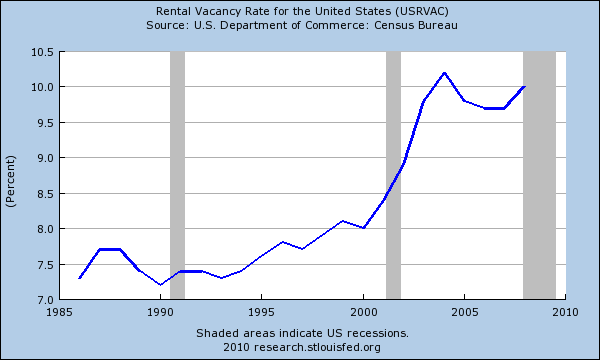
At the same time, the massive glut of housing units is still out in the market:
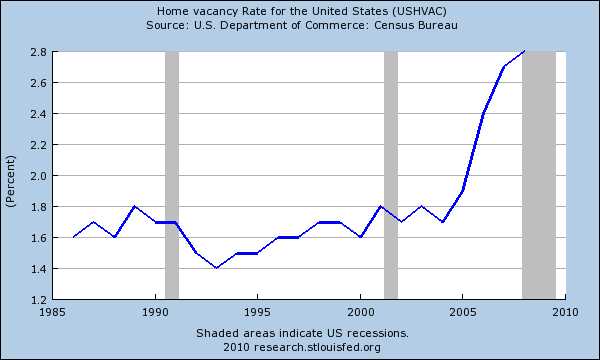
To put this in perspective, we added 724,000 households from 2007 to 2008. From 2006 to 2007 we added 760,000 households. Hard to see a recovery happening when working and middle class families are actually decreasing the amount of households while a glut of real estate is out in the market.
If you enjoyed this post click here to subscribe to a complete feed and stay up to date with today’s challenging market!Article Source
BACK to margotbworldnews.com
Sunday, August 29, 2010
Graduates warned of record 70 applicants for every job
Class of 2010 told to consider flipping burgers or shelf stacking to build skills as they also compete with last year's graduates
Waiting to graduate is increasingly being followed by waiting to work as competition for jobs increases. Photograph: Matthew Power/Rex Features
Graduates are facing the most intense scramble in a decade to get a job this summer, as a poll of employers reveals the number of applications for each vacancy has surged to nearly 70 while the number of available positions is predicted to fall by nearly 7%.
The class of 2010 have been told to consider flipping burgers or stacking shelves when they leave university as leading firms in investment banking, law and IT are due to cut graduate jobs this year.
Competition in the jobs market is fiercer now than for the first "post-crunch" generation of students, last year, when there were 48 applications for each vacancy.
The number of applicants chasing each job is so high that nearly 78% of employers are insisting on a 2.1 degree, rendering a 2.2 marginal and effectively ruling out any graduates with a third, according to the survey published tomorrow.
The Association of Graduate Recruiters polled over 200 firms including Cadbury, Marks & Spencer, JP Morgan and Vodafone and found the number of applications per vacancy had risen to 68.8 this year, the highest figure recorded. In the most hotly contested sector – makers of fast-moving consumer goods such as food, confectionery and cosmetics – there were 205 applications for each job.
Carl Gilleard, the association's chief executive, said graduates needed to be more flexible in their career choices. "They need both short-term and long-term career goals because you're graduating in a very tough climate. It doesn't mean you should be put off applying for the profession of your choice.
"Any employment is better than no employment [even] if it's about flipping burgers or stacking shelves rather than being sat at home feeling sorry for yourself and vegetating. There are lots of other skills required and valued, like people skills: you could be on a counter in a store. It's all about building up your skills base. The big fear is that some people just drop off the bottom of the scale – because confidence goes very rapidly."
Gilleard warned that employers were raising the bar on degrees, and graduates with a 2.2 or worse faced being filtered out by automated applications. "There are dangers in that. You can miss out on some very good candidates."
He said it was too early to say whether this trend would lead to graduates with a 2.2 being excluded from the job market altogether.
In 2008, when the economy was buoyant, just 57% of employers insisted on a 2.1 or higher. Last year that rose to 60%. "We need to wait for 2011 to see if this is a trend," he said.
Graduate salaries are frozen at an average of £25,000, the first time in the survey's history that starting salaries have remained stagnant for two consecutive years. But there is some positive news; the survey noted a revival in banking, the insurance sector and accountancy where vacancies were predicted to rise this year.
Apprenticeships, which are likely to expand under the coalition government, might provide an alternative career path for some students, the survey noted.
Gilleard acknowledged there was snobbery about apprenticeships, but said the children of the middle classes should not assume they had to get a degree to succeed. "I think many middle class parents are actually questioning, is this [a degree] the right route that my son or daughter should follow
.
"Too many young people go [to university] because it's expected of them, and they don't think it through from a personal perspective – what will it be like, apart from having a good time."
As applications for university places continue to soar, the government has urged universities to publish statements revealing the help they offer to get their students ready for work.
Responding to the survey, the minister for universities, David Willetts, said: "The job market remains challenging for new graduates, as it does for others.
"But a degree is still a good investment in the long term, and graduates have a key role to play in helping Britain out of the recession. We are committed to making it easier for current graduates to find work. That is why I have just asked all universities to provide statements on employability for their students."
The president of the National Union of Students, Aaron Porter, urged the government to invest in creating jobs and training: "We are concerned that the savage cuts to the public sector will create further unemployment, and will make the lives of graduates tougher in an already difficult jobs market."
For the fourth year in a row, demand for university places has hit a record high.
At the end of May, there were over 640,000 applications for places this autumn – an increase of nearly 14% on last year.
As universities face an increased challenge in selecting the best candidates, there is some skepticism about the new A* grade, being awarded for the first time this summer in an attempt to distinguish the cream of the crop.
Fewer than a third of university admissions officers believe the A* grade would be crucial in selecting the most able students, according to a separate survey published today.
While over half of the 40 admissions officers surveyed believed grade inflation made it harder to pick the best candidates, fewer than a third thought the A* was "essential".
The survey was commissioned by a network of international schools which favour a rival qualification, the international baccalaureate.
Graduate's story: 'The only way in is unpaid work'
Article Source
BACK to margotbworldnews.com
Subscribe to:
Posts (Atom)